
 CONFERENCE
Community garden
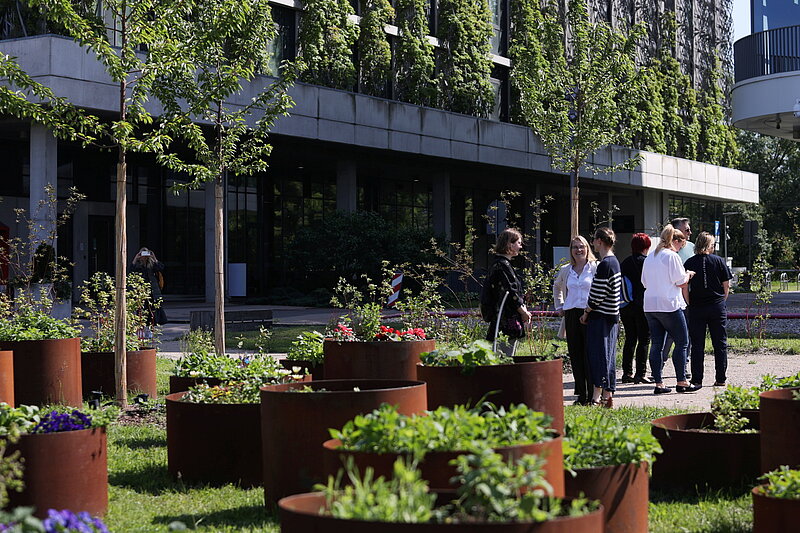
With the aim of opening the territory of the University of Latvia Academic Centre to sustainable interaction between nature, the environment, and people, the first University of Latvia Community Garden was officially opened on 14 June 2025.
The garden has been created as an open and inclusive space for everyone – both for those who wish to engage in gardening and cultivate their own greenery or flower beds, and for those who simply want to relax, meet others, or learn in a green environment. It is envisioned as a place where everyday university life can naturally intertwine with nature, well-being, and community.
The LU Community Garden is located in the green zone next to the House of Science at the University of Latvia, Jelgavas Street 3, Riga.
At present, all raised beds have been assigned to gardeners. However, those interested in cultivating a raised bed in the future are invited to contact the Eco-Council via email at ekopadome@lu.lv, which will allow communication should a bed become available. Visitors to the LU Community Garden are kindly asked to respect the shared agreement on mindful and considerate use of the garden area, to treat gardeners’ work with care, and to enjoy the harvest visually rather than by picking it.
The green courtyard of the LU Academic Centre is home to 45 rust-coloured raised beds, which have already found their dedicated caretakers. This spring, strawberries are ripening for the first time, dill is sprouting, basil is filling the air with its scent, cherry tomatoes are taking shape, and colourful flowers are in bloom. Alongside newly planted cherry trees, several relaxation areas have been created, including conversation and dining tables with special recesses soon to be filled with herbs, as well as loungers and benches designed for quiet reflection, studying, or rest.
In addition, city meadows are being managed within the LU Academic Centre territory in line with biodiversity-friendly principles. These meadows are also part of the wider Riga city meadow network, further strengthening the connection between the University, urban nature, and sustainable land management.